
Why Your Cape Coral AC Freezes Up Mid-Summer: The Airflow vs. Refrigerant Diagnosis That Determines a $150 Fix or a $600 One
You walk outside on a 95-degree Cape Coral afternoon and find your outdoor unit's line covered in what looks like a thin white blanket of frost. Or maybe it's the indoor coil — the air handler in the garage or closet dripping water everywhere, barely blowing anything out of the vents. Either way, your first instinct is probably to crank the thermostat down and hope the AC "fights through it." That's the one move that almost guarantees a bigger repair bill.
A frozen AC in the middle of a Southwest Florida summer almost always comes down to one of two root causes, and they lead to two very different invoices. The good news: there's a simple, homeowner-level way to tell which one you're dealing with before you ever pick up the phone.
Why Ice Forms on an AC That's Supposed to Be Cold, Not Frozen
Your AC's indoor evaporator coil runs cold — usually somewhere around 35-40°F — because that's how it pulls heat and humidity out of the air moving across it. As long as warm house air keeps flowing across that coil at a steady rate, the coil stays right around that temperature and nothing freezes.
Ice shows up when that balance breaks in one of two directions:
- Not enough warm air reaches the coil. Airflow drops, the coil gets colder than it should, and moisture in the air starts freezing directly onto the coil's fins instead of draining away as condensation.
- Not enough refrigerant is moving through the coil. A leak drops the system's refrigerant charge, the coil pressure falls, and the coil temperature drops low enough to freeze — even with normal airflow across it.
Same symptom, two completely different fixes. Here's how to tell them apart.
Airflow Problems: The $150-ish Fix
Airflow issues are by far the more common reason Cape Coral homeowners find a frozen coil in July and August, mostly because Florida's humidity makes any airflow restriction worse than it would be in a drier climate. A few things to check before you call anyone:
Start with the filter
A dirty, clogged filter is the single most common cause of a frozen coil. If yours hasn't been changed in more than 60-90 days — or you run pets, renovations, or a lot of foot traffic through the house — pull it and hold it up to a light. If you can't see light through it, that's very likely your problem. A clean filter alone resolves a surprising number of "frozen AC" calls.
Check every vent and return
Walk the house and make sure supply vents aren't closed or blocked by furniture, rugs, or curtains, and that the return air grille has clear space in front of it. Closing vents in unused rooms to "save money" is one of the most common ways Cape Coral homeowners accidentally starve their own system of airflow.
Listen to the blower
If the filter's clean and the vents are open but airflow at the registers still feels weak, the blower motor, a collapsed flex duct, or a dirty evaporator coil (from years of skipped filter changes) could be restricting flow further upstream. That's still an airflow problem — just one that needs a tech's eyes rather than a fresh filter.
Refrigerant Problems: The Bigger Repair
If the filter's clean, every vent is open, and the blower sounds and feels normal, but the coil or the line set is still icing up, refrigerant is the more likely culprit. Refrigerant doesn't get "used up" during normal operation — a system that's low on charge has a leak somewhere in the coil, line set, or a fitting. Common signs that point this direction instead of airflow:
- The outdoor copper line (not just the indoor coil) is frosted or icy, especially near the unit.
- The system runs long cycles but the house never quite reaches the set temperature, even before ice shows up.
- A hissing or bubbling sound near the outdoor unit, which can point to a leak point directly.
- This isn't the first time — a system that's iced up before is a system with a leak that was patched or topped off rather than found and repaired.
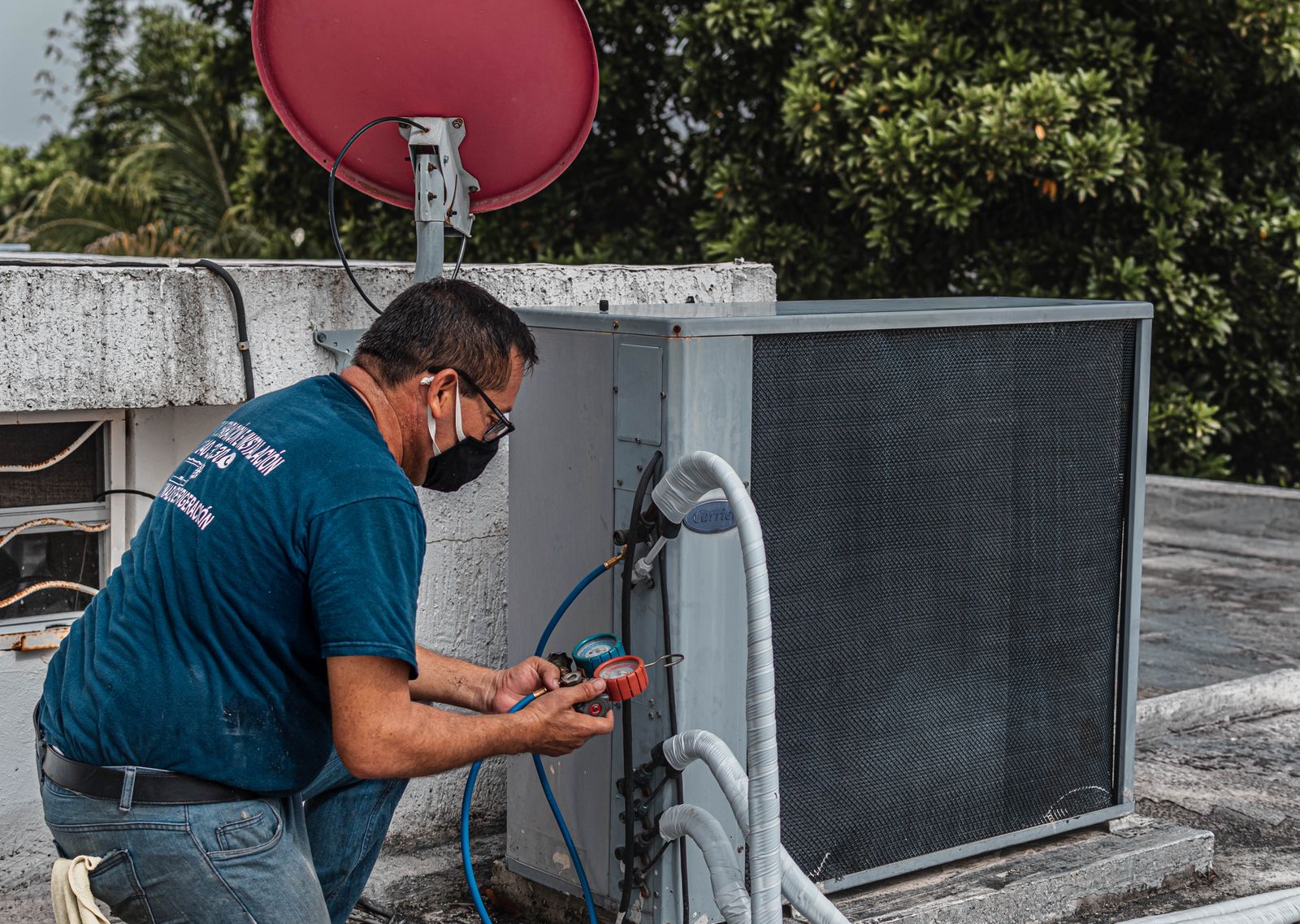
Diagnosing a refrigerant issue correctly requires a licensed technician with gauges — connecting a manifold set to read suction and head pressure is the only reliable way to confirm low charge versus normal charge with an airflow restriction. From there, the repair path depends on where the leak is: a fitting or valve can sometimes be resolved with a repair and recharge, while a leak inside the coil itself often means the coil (or in older, out-of-warranty systems, the whole outdoor unit) needs to be replaced rather than topped off again. Simply adding refrigerant without finding and fixing the leak is a temporary patch — the system will ice up again, usually within a season.
What Not to Do While You're Frozen Up
Whichever cause you're dealing with, running a frozen system makes things worse, not better:
- Don't crank the thermostat lower. The system isn't cooling because it's frozen, not because it needs to work harder — a lower setpoint just keeps it running against the same blockage.
- Don't keep running the AC once you spot ice. A compressor that keeps trying to pump refrigerant through an iced, restricted system can suffer real damage, turning an inexpensive fix into a compressor replacement.
- Do switch the thermostat to fan-only or off and give the coil several hours (sometimes overnight) to thaw completely before diagnosing anything further or restarting the system.
When to Call Seven Level Air
If a fresh filter and open vents don't solve it within a day, or the ice keeps coming back after it thaws, that's your signal it's refrigerant-side and needs a licensed diagnosis rather than another guess. Our techs carry gauges on every truck and can usually tell you within the first 20 minutes on site whether you're looking at an airflow fix or a refrigerant leak — and give you a real number before any work starts, backed by our guarantee. No guesswork, no upsell on a part you don't need.
Frozen AC in Cape Coral or Fort Myers right now? Give us a call or reach out here and we'll get a tech out to diagnose it properly the first time.

